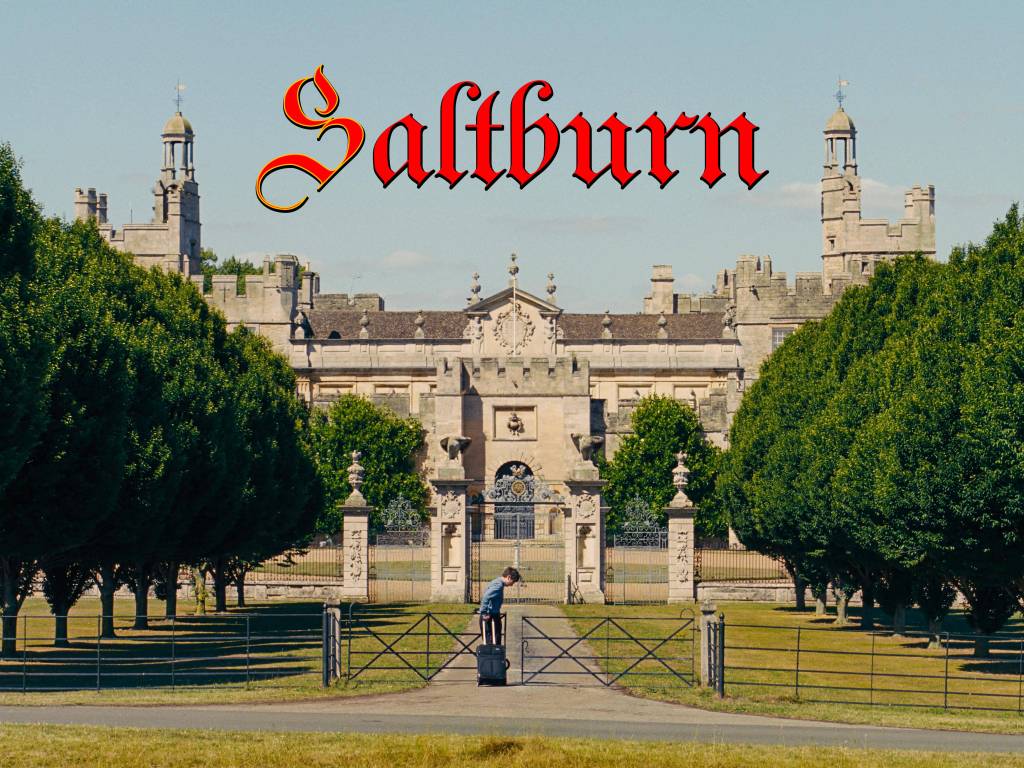
When stories are set mostly in a single location, a building will often become a character in and of itself such as in Malcolm And Marie (2021) where a couple argue around Caterpillar House for the movie’s 106 minute runtime, and Call Me By Your Name (2017) which follows a romance in the hallways of a remote villa in Italy. When left alone with a building, we watch the characters’ behaviour and growth become defined by it. The story is the same for Saltburn. The mansion and its effects are anything but subtle – but what did the house do, and what does it become?
We are introduced to Saltburn after Felix Catton invites adoring and tragic Oxford peer Oliver Quick to his family home for the holidays. Oliver first makes a relatable fool of himself arriving before the gates are opened for him and looking for the doorbell in an ostentatious porch. Then, in a scene barely lasting a minute, Felix, barefoot, gives a casual and uncaring tour of the sprawling rooms (the red staircase, the green room, the blue room, the long gallery, and their suite of rooms), casually dismissing lavish design with nonchalance and outrageous anecdotes.
The building, really Drayton House in Northamptonshire, was a 14th century fortified medieval house reconfigured by the early 18th century into the English Baroque style it is now. Through a little movie magic, Felix’s fantastic sprawling tour changes level twice, and well-placed cuts take them to different parts of the house, though all scenes were shot on location.
The house’s crenelations (a toothed castle-like roof edge) speak to its original fortification, while a formal tree-lined drive and relative isolation in the countryside make it an imposing and threatening mass to approach. This is a house that protects its occupants and fiercely discourages those who would approach it. Its iconic towers and beautiful baroque features are symbols of inordinate wealth, but the building’s defensiveness speaks to the untouchable status such wealth provides, physically, and within society at large.
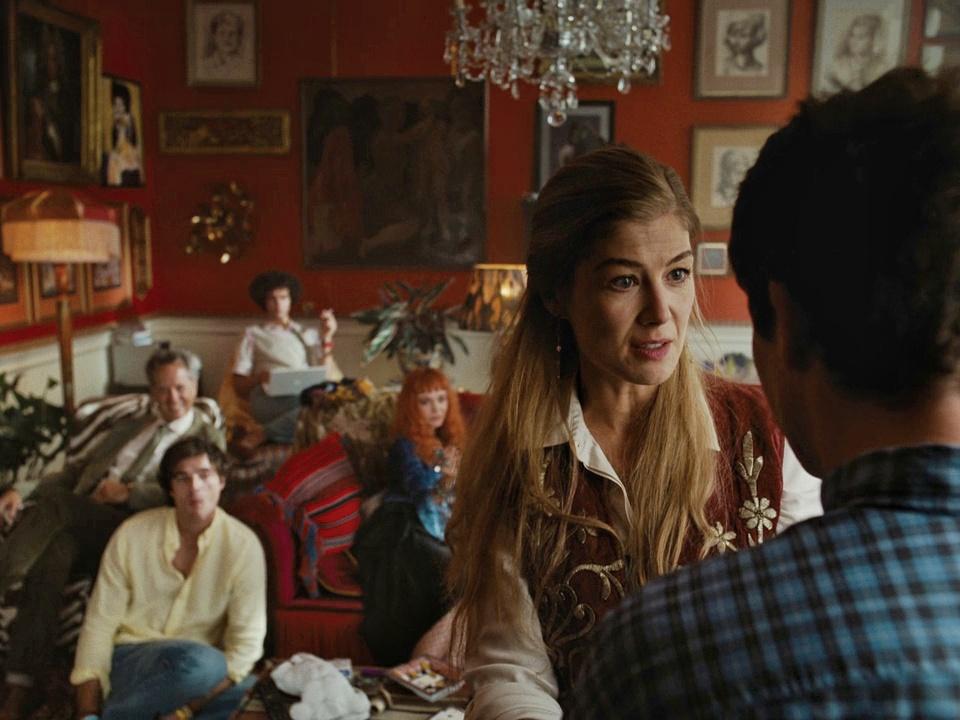
In interviews with Vanity Fair and Reign, director Emerald Fennell describes the film as an interrogation of “our obsession with beauty” and of our “relationship with our own desire.” At Oxford, Oliver becomes transfixed by Felix, and later, by Venetia, Elsebeth and the Saltburn house. This obsession goes both ways, the Catton family ostensibly having their own “fetish for broken birds” (Esquire), Elsebeth with dull but beautiful Pamela, and Felix with Oliver.
The family’s idiosyncratic ignorance of crises and odd neuroses might first be attributed to extreme wealth, but as the film progresses and Oliver descends into calculated madness it becomes clear that this house, the film’s namesake, is at least in part to blame. Beyond a light and insincere commentary on class, the mansion symbolises isolation and disconnect, from reality, from normalcy, and from sincere empathy.
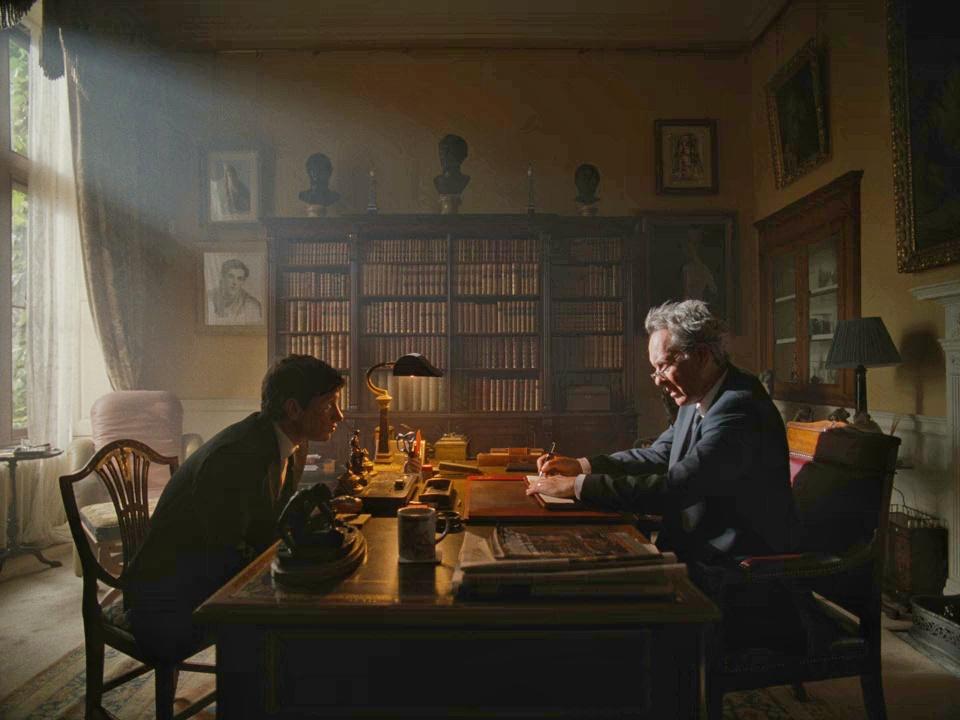
As Oliver spends more time at the house over the summer, we see his obsessions shift methodically from character to character, before we realise, too late, that he is instead after the house and the status that it affords. In a tense, music-less scene between Oliver and James Catton, owner of the house, Oliver is pleaded with to leave Saltburn and the grieving couple alone, and in this moment it becomes apparent that Oliver’s fixation and fantasies extend beyond having Felix and the Cattons as his own, to having their house and life.
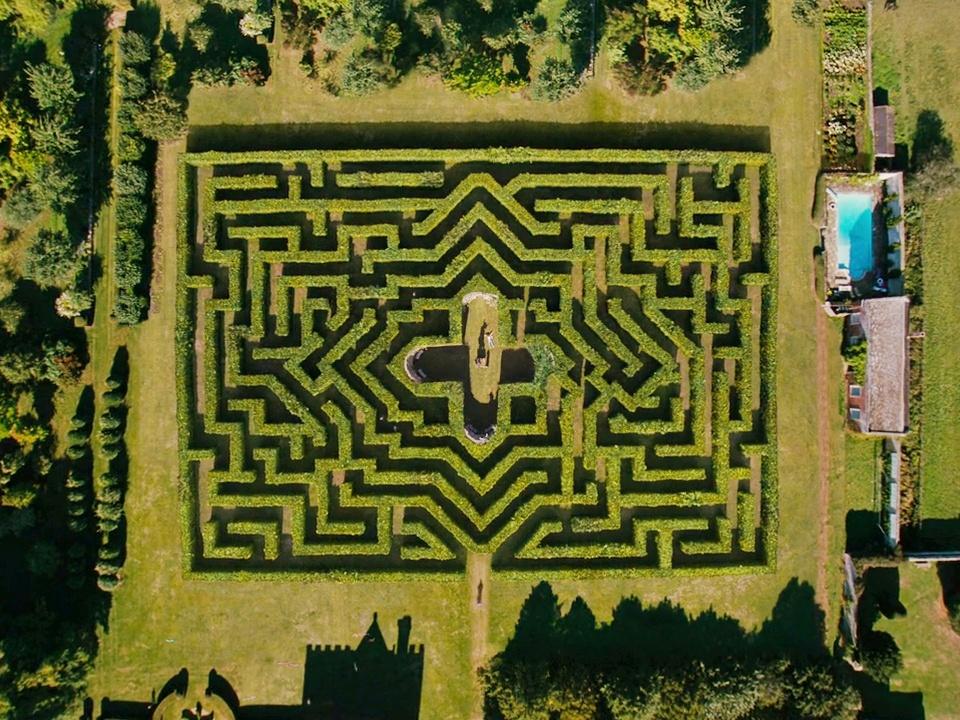
In Greek mythological allegory of wilfully trapping and disorienting oneself, the maze and Minotaur statue on Saltburn’s grounds feature grimly during the first death, when Oliver kills Felix at the maze’s centre. It marks a point of no return as Oliver, now having been rumbled by Felix, gives up on humane appeals and begins to lose himself, reality and any remaining guise of normalcy. Much like the Catton’s idiosyncrasies, Oliver’s condition is a symptom of Saltburn. Unfortunately, Oliver, unlike Theseus, does not leave behind a string to trace his way back out. Saltburn and Oliver’s tangled web of transgressions, leave him ultimately protected and distant, and at the centre of an isolating Labyrinth.
In a comedic final scene, set to ‘Murder On The Dance Floor’ Oliver retraces Felix’s initial house tour in reverse, nude. Beginning at the King’s Bedroom (which he now presumably occupies) he dances through the house and we know he has won. Saltburn belongs to him, and he belongs to Saltburn.
 Laurence Łucasz